
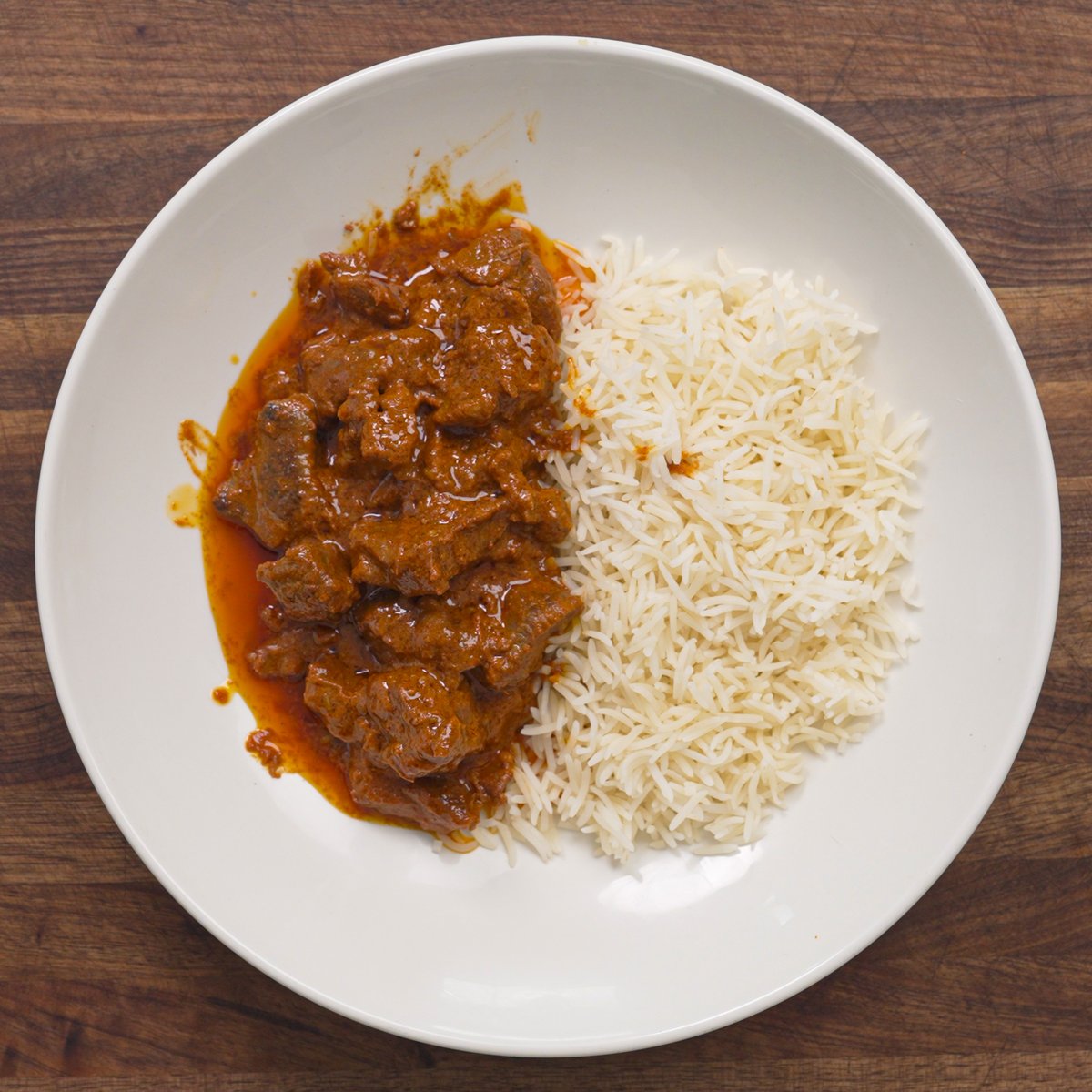
Rogan Josh
A heavily spiced braised lamb dish with origins from the Kashmir Valley in India.
 Ethan Chlebowski
Ingredients
Braising cut
- Lamb stew meat1000 g~2 lbs
- Mustard oil75 g4-6 spoonfuls
- Saltto taste
Whole spices
- Bay Leaves2
- Cinnamon sticks1 small stick
- Mace2 pieces
- Black cardamom2 pods
- Nutmeg1/4
- Whole cloves3-4
Ground spices
- Kashmiri Chili Powder20 g2 spoonfuls
- Cumin10 ga spoonful
- Fennel Seeds, crushed5 g1/2 spoonful
- Garam Masala5 g1/2 spoonful
- Ground Ginger3 g1/4 spoonful
- Asafetida2 ga sprinkle
Braising liquid
- Whole Milk Yogurt~200 g6-8 oz
- Wateras neededto cover braise
Serving options
- Basmati Rice
- Roti flatbreads, or naan or paratha
Method
Step 1: Bloom the whole spices & brown the lamb
Add enough oil to generously coat the bottom of a heavy pot. Turn on the heat to medium high and add the whole spices to the oil. Add the cubed lamb & a light sprinkle of salt.
As the oil heats, the spices will and release their aromas. While stirring occasionally, continue to cook the lamb/spice mixture for about 5 minutes to achieve light on the meat.
Step 2: Mix & add the yogurt mixture
Meanwhile, mix together the yogurt and all of the ground spices until well combined.
Once the lamb & spices have cooked for at least 5 minutes, add the yogurt mixture to the pot (be careful, it might sputter).
Stir to combine & bring to a .
Step 3: Braise until tender
Top everything off with just enough water to barely submerge the pieces of meat. Stir, return to a light , and partially cover.
for 1-2 hours until the lamb pieces are completely tender. (You can do this by leaving it cooking on the stovetop or in a 300°F/150°C oven.)
While this braises, cook some basmati rice or prep any other serving options like roti flatbreads.
Step 4: Finish & serve
Once the lamb is tender, turn off the heat. Taste and season the mixture with salt if needed.
Optional step: Add a few drops of natural red food dye to deepen the color. Many people adjust the color of this dish with natural dyes or traditional coloring agents like ratan jot root.
Serve warm over rice or with roti flatbreads.
“A dish I found in my exploration of global braising recipes. I went to an Indian grocer to source mustard oil & spices, but you could make this dish with more accessible ingredients like neutral cooking oil and a pre-mixed pack of Rogan Josh Masala spices.”
Ethan ChlebowskiWatch & Cook
Nutritional Information
Show macros split into…
Recommended: 6 servings
FAQ
Should this be made with mutton or lamb?
Mutton is lamb that is older than 12 months in age. Traditionally this dish is made with mutton, but any lamb stew meat will work, especially since mutton is rarely sold in US markets. If you can’t find pre-chopped lamb stew meat, any shoulder/shank/leg can work, just clean and cube it up.
What kind of yogurt should I use?
Use a thick, plain, unsweetened yogurt—ideally whole-milk yogurt. Full-fat Greek yogurt also works if thinned slightly with water. Avoid flavored yogurts or low-fat yogurts, which can curdle more during braising and become grainy.
Do I have to use all of these spices?
Use as many as you can find, or buy a “rogan josh masala mix,” which are commonly available at Indian or international grocery stores, or online.
Is kashmiri chili powder spicy?
Kashmiri chili powder is fairly mild, despite it’s deep red that may look very . Usually, kashmiri chili powder only adds a light kick, around 1000 to 2000 scoville units. Jalapeños, by comparison, range from 2500-8000 scoville units. If you substitute with other red chili powders, they might add more heat to the dish and not as much color.
I thought this dish was supposed to be bright red?
Rogan Josh is known for its deep red color. Some of that comes from Kashmiri chili powder, but traditionally the bigger contributor is ratan jot—the dried root of the alkanet plant—which releases a natural red dye when added to the dish.
When ratan jot isn’t available, the color can be deepened with just a couple drops of natural red food dye.
And that visual impact matters. We eat with our eyes first, and even small shifts in can make a dish feel richer and more appealing.